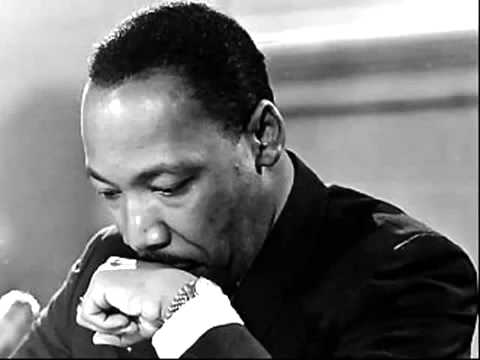
Dr. Martin Luther King Jr., „Beyond Vietnam” (4 Aprilie 1967)

„We must rapidly begin the shift from a thing-oriented society to a person-oriented society. […] machines and computers, profit motives and property rights are considered more important than people […].

A true revolution of values will soon cause us to question the fairness and justice of many of our past and present policies. […] True compassion is more than flinging a coin to a beggar. It comes to see that an edifice which produces beggars needs restructuring.

A true revolution of values will soon look uneasily on the glaring contrast of poverty and wealth. With righteous indignation, it will look across the seas and see individual capitalists […] investing huge sums of money […], only to take the profits out with no concern for the social betterment of the countries, and say: „This is not just.” […] The Western arrogance of feeling that it has everything to teach others and nothing to learn from them is not just.

[…]

This kind of positive revolution of values is our best defense against communism. […] These are days which demand wise restraint and calm reasonableness. We must not engage in a negative anti-communism, but rather in a positive thrust for democracy, realizing that our greatest defense against communism is to take offensive action in behalf of justice. We must with positive action seek to remove those conditions of poverty, insecurity, and injustice which are the fertile soil in which the seed of communism grows and develops.

These are revolutionary times. All over the globe men are revolting against old systems of exploitation and oppression, and out of the wounds of a frail world new systems of justice and equality are being born. The shirtless and barefoot people of the land are rising up as never before. The people who sat in darkness have seen a great light.

[…]

It is a sad fact that because of comfort, complacency, a morbid fear of communism, and our proneness to adjust to injustice, the Western nations that initiated so much of the revolutionary spirit of the modern world have now become the arch anti-revolutionaries. This has driven many to feel that only Marxism has a revolutionary spirit. Therefore, communism is a judgement against our failure to make democracy real and follow through on the revolutions that we initiated. Our only hope today lies in our ability to recapture the revolutionary spirit and go out into a sometimes hostile world declaring eternal hostility to poverty, […]. With this powerful commitment we shall boldly challenge the status quo and unjust mores, and thereby speed the day when “every valley shall be exalted, and every mountain and hill shall be made low; the crooked shall be made straight, and the rough places plain.”

A genuine revolution of values means in the final analysis that our loyalties must become ecumenical rather than sectional. Every nation must now develop an overriding loyalty to mankind as a whole in order to preserve the best in their individual societies.

This call for a worldwide fellowship that lifts neighborly concern beyond one’s tribe, race, class and nation is in reality a call for an all-embracing and unconditional love for all mankind. This oft misunderstood, this oft misinterpreted concept, so readily dismissed by the Nietzsches of the world as a weak and cowardly force, has now become an absolute necessity for the survival of man. When I speak of love I am not speaking of some sentimental and weak response. I’m not speaking of that force which is just emotional bosh. I am speaking of that force which all of the great religions have seen as the supreme unifying principle of life. Love is somehow the key that unlocks the door which leads to ultimate reality. This Hindu-Moslem-Christian-Jewish- Buddhist belief about ultimate reality is beautifully summed up in the first epistle of Saint John: „Let us love one another, for love is God. And every one that loveth is born of God and knoweth God. He that loveth not knoweth not God, for God is love.” „If we love one another, God dwelleth in us and his love is perfected in us.” Let us hope that this spirit will become the order of the day.

We can no longer afford to worship the god of hate or bow before the altar of retaliation. The oceans of history are made turbulent by the ever-rising tides of hate. History is cluttered with the wreckage of nations and individuals that pursued this self-defeating path of hate. As Arnold Toynbee says: „Love is the ultimate force that makes for the saving choice of life and good against the damning choice of death and evil. Therefore the first hope in our inventory must be the hope that love is going to have the last word.”

We are now faced with the fact, my friends, that tomorrow is today. We are confronted with the fierce urgency of now. In this unfolding conundrum of life and history, there is such a thing as being too late. Procrastination is still the thief of time. Life often leaves us standing bare, naked, and dejected with a lost opportunity. The tide in the affairs of men does not remain at flood—it ebbs. We may cry out desperately for time to pause in her passage, but time is adamant to every plea and rushes on. Over the bleached bones and jumbled residues of numerous civilizations are written the pathetic words, „Too late.” There is an invisible book of life that faithfully records our vigilance or our neglect. Omar Khayyam is right: „The moving finger writes, and having writ moves on.”

We still have a choice today: nonviolent coexistence or violent co-annihilation. We must move past indecision to action. We must find new ways to speak for peace […] and justice throughout the developing world, a world that borders on our doors. If we do not act, we shall surely be dragged down the long, dark, and shameful corridors of time reserved for those who possess power without compassion, might without morality, and strength without sight.”

Source: https://www2.hawaii.edu/~freeman/courses/phil100/17.%20MLK%20Beyond%20Vietnam.pdf
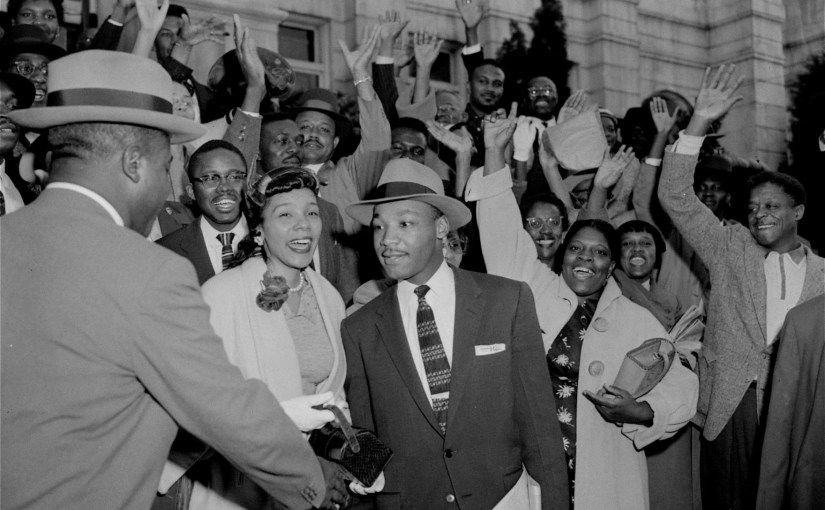
King, Martin Luther, Jr. (18 Martie 1956), „When Peace Becomes Obnoxious”

„Peace is not merely the absence of some negative force—war, tensions, confusion but it is the presence of some positive force—justice, goodwill, the power of the kingdom of God.

[…] peace is not merely to absence of this tension, but the presence of justice. And even if we didn’t have this tension, we still wouldn’t have positive peace.

[…] it is true that if [one] accepts his place, accepts exploitation, and injustice, there will be peace. But it would be an obnoxious peace. It would be a peace that boiled down to stagnant complacency, deadening passivity and if peace means this, I don’t want peace:

– If peace means accepting second class citizen ship, I don’t want it;

– If peace means keeping my mouth shut in the midst of injustice and evil, I don’t want it;

– If peace means being complacently adjusted to a deadening status quo, I don’t want peace;

– If peace means a willingness to be exploited economically, dominated politically, humiliated and segregated, I don’t want peace.

In a passive non-violent manner we must revolt against this peace.

[…] Peace is the presence of positive good.”

Source: https://kinginstitute.stanford.edu/king-papers/documents/when-peace-becomes-obnoxious

11 Days of Wander – The Names We Bear

In the depths of the forest, far away from pain, from sorrow, away from the rainy days and the whiff of must, the birds are chirping, singing the song of life; heard only by those who are good-hearted.

In these depths, you can hear the river streaming down, water carving the rocks, grinding them into finely-shaped forms, as if for a wedding. A wedding where all the trees are grooms and brides, with a veil made only of blossoms; a veil so long and so dense, its intricate layers of leaves cover the green and soft foliage of the forest.

In this remoteness of forgotten land, even God has not laid His hand, and the Devil would need a second apple to even acknowledge these woods.

All beings who needed to be here were born here or brought here for pressing reasons. In these depths, near the river, we find a kid lying down. Who is he? What is he doing? Such questions trouble not only our minds but also someone else’s. A young man perched in a tree, about 18 years old, watches the kid and wonders:

“He is wearing weird clothes, different from ours. His shirt, with some strange inscriptions, makes me wonder which kingdom he might represent. And what’s that glass on his eyes? If he’s dead, shouldn’t there be coins, not glass?”

“Hmm, he seems like he is sleeping. Why would he sleep in the middle of the day in a God-forsaken forest? Hmm… he’s waking up. Quick, greet him, Joe. You’ll finally have a friend.”

“Oh, you are finally awake!” says Joe, grinning mischievously.

The kid opens his eyes and takes a quick glance around, a grim look etched on his face. He seems lost, troubled, and full of questions.

“Hey, boy, what’s your name?” asks Joe.

Suddenly, the kid panics and starts running wildly. Before he knows it, he smacks his head into a tree.

“Bam! That must have hurt,” says Joe with a smirk.

“Tsss, what’s going on? Why does this dream feel so real? And if it’s not a dream, how did I get here? If this is a prank… well, I got nothing,” the kid mutters, taking a deep breath.

“So many questions… so many questions. I have them too. You like to ask. Perhaps you asked too much, and that’s why you are here,” Joe mocks.

“Great! And now he sings,” Joe mutters.

“Alone… somewhere… over the rainbow, way up high, and the…”

“Hey, you are not alone. I am here!”

The kid keeps singing, as if waiting for the dream to end.

“Boy, can you hear me? I’m here. Yellooow!”

“Don’t bother, Joe. He is not aware of us. He is in our minds. He is our God,” says a soft, girly voice.

“What do you mean? He is a boy, not a God. He is here, but he refuses to talk to me. Such stubbornness.”

“No, Joe. We are his gods. He is here because we created him,” echoes a darker, deeper voice from the shadows.

“I do not recall doing such things, nor being aware of such powers.”

“Oh, Joe. You make me sad.”

“You are always sad, Merlin.”

“Ah, don’t call me that.”

“Sorry, Rose. Please don’t cry. Let me cheer you up.”

Joe jumps down from the tree and starts twirling around, singing and dancing like a lunatic.

“Spiders, cats, and creepy dogs / Jump around the deadly corpses / Eat their brains and make them new / Make them puppets just for you!”

“Thank you, Joe,” says Rose. “I already feel better.”

“Really?” asks the same dark voice.

“What did you think, Ako? My voice is beautiful!”

All of a sudden, the kid stops singing. Has he finally realized this is not a dream? As silence embraces the forest, the kid speaks:

“Who are you?”

Joe, Rose, and Ako turn around, their eyes wide with surprise.

“Boy, are you talking to us?” says Joe.

“Hey! Why don’t you answer?”

“Are you talking to me?” asks Rose.

“You perv! Is that why you didn’t answer me earlier?” Joe retorts. “You care only about girls?!”

While Joe rages, Ako steps back. He stares at the ground, as though wishing to remain unnoticed.

“Hey! I know you!” says the kid, his voice rising. “Why don’t you answer me?”

Joe and Rose turn their gaze to Ako, who is visibly distressed.

“Ako,” says Rose. “What is this about?”

“I know him, somehow…” Ako replies.

The kid steps forward, long and silent.

“What did you say? Don’t you remember me? It is me! Morde! Remember?”

“I know you, somehow. I just don’t remember where from… How?”

“I do not know. But the truth is, I have always expected, somehow, something like this.”

“What are you saying?”

“You look exactly like something that wandered through my mind a long time ago.”

“I wandered your mind?”

“What is your name?” yells the kid suddenly.

Ako feels a shiver run down his spine. He steps back, his deep, heavy voice now barely audible:

“I… am… Ako.”

“Fantastic! This is getting better. Weird, scary, but exciting!”

Ako finds no words to reply.

Joe and Rose exchange amazed glances.

“Ask him what’s so exciting about it!” Joe shouts at Ako.

“What’s so exciting?”

“You! This! If your name is Ako, then it is you!”

As if regaining his strength, Ako asks in a confident tone:

“And who am I?”

“You, my beloved Ako, are my protector. You are the character I have always dreamed of. You are the main star in all my stories. You, Ako! You are my first-class hero in all my writings. You are fictive! You should not exist!”

“I shouldn’t?”

“But he is real!” exclaim Joe and Rose.

“Yes, I am!” yells Ako.

“Tell me, Ako. Are there Storm, Frey, Joe, or Rose?”

Ako’s eyes widen in fear, and he stares at the kid, mesmerized and terrified.

“You—you, hear th…” Before finishing his question, Rose interrupts.

“I did.”

“Oh, boy. We did,” adds Joe. “Should we trust him? Quick, ask him his name.”

“What’s your name?” asks Ako, almost absentmindedly.

“I am your God, as… I believe you guys said moments ago.”

All three fall into a deep silence. They cannot believe what they have just heard. But Joe, still unsatisfied, steps forward and yells:

“Ya! This boy is toying with us. He heard us before, and now he is toying with us. He thinks we are—”

Before Joe finishes, the kid swiftly replies:

“You are anything but fools, Joe.”

“What?” asks Joe.

“I am telling you. The guy is nuts. Probably bored. A loony?”

“Was that what you were about to say, Joe?”

“H-how?”

Ako’s mind is elsewhere. His body stands there, numb, before everyone’s eyes.

11 Days of Wander – Foreword

There are many beliefs, many theories, and many interpretations about the afterlife.

Some believe that after we die, we go to a beautiful and peaceful place meant only for those who are good at heart—the good-intended. This place is called heaven. On the other hand, some believe that one may fall into a dark pit illuminated by flames, scorched by fire, meant for those who disobeyed divine laws and sacrificed others’ love, life, and happiness for their own selfish achievements. This is a place of suffering often referred to as Hell.

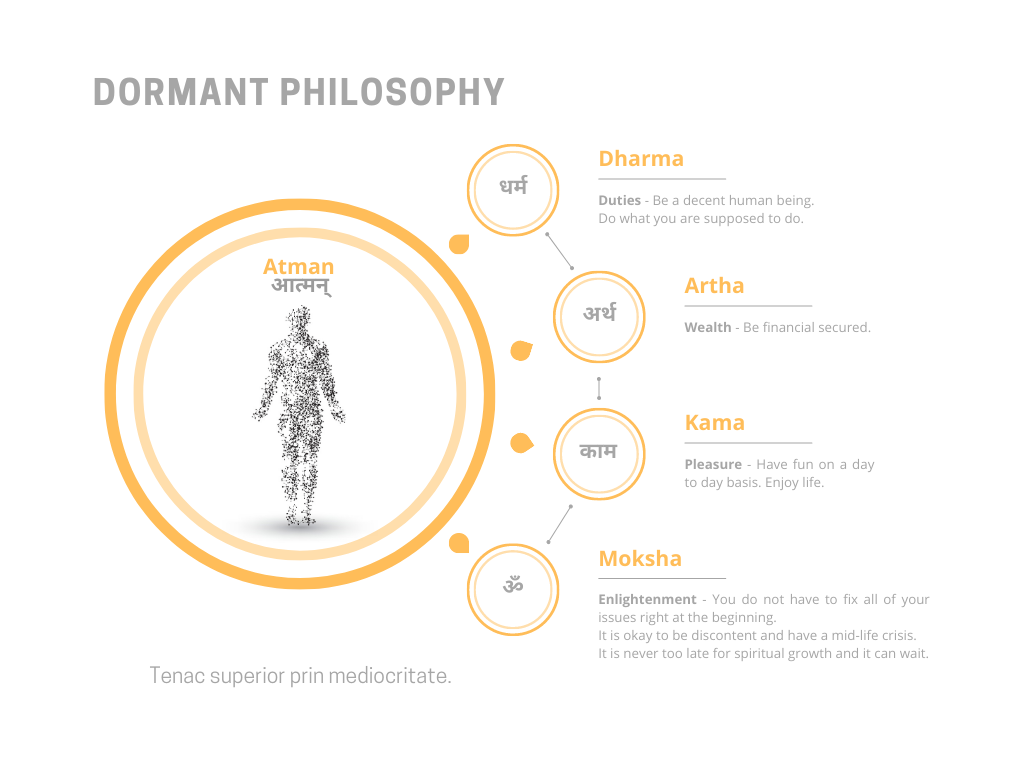
Others believe that the soul is trapped in a constant cycle of death and rebirth, driven by desires and cravings for worldly attachments. This cycle is known as Samsara. Their mission, or ultimate goal, is to break free from this spinning wheel and achieve liberation, freedom from all desires and cravings. In Hinduism, this liberation is called Moksha, and it signifies the merging of the individual soul (Atman) with the universal reality (Brahman).

Some views of life emphasize suffering as a central theme, portraying existence in Samsara as filled with pain rather than exotic or romantic notions. The soul, or “deep self,” is bound in Samsara by the laws of karma. In this belief system, past actions greatly influence future lives, determining whether one is reborn into favorable or challenging circumstances. Sins and misdeeds may result in temporary punishment in Naraka (a form of Hell), where the soul atones for its wrongdoings before continuing the cycle of rebirth.

Fortunately, there are many ways to escape this cycle of death and rebirth. These include performing rituals, practicing yoga, gaining spiritual knowledge, and understanding one’s connection with nature. When a soul achieves Moksha, it is liberated, like a drop of water merging with the vast ocean. It becomes one with the cosmic Brahman, often described as “the unitary ground of being that transcends particular gods and goddesses.”

All these attempts to understand what happens after death are not mere fantasies. While they remain unproven, they represent profound philosophical and spiritual efforts to make sense of the unknown.

Übermensch of the future

Consciousness is in us – A glimpse

A life-long project:

to write about the connection between the works of Alan Watts and Hinduism, Peterson and neuroscience, Jung and the role, Russel Brand and socio-economical-politics glued in-between with some Nietzsche, John Stuart Mill, Victor Frankl, Aristotle, Albert Camus, with a frosting of history, anthropology and loads of semiotics.

image

I disagree. I believe that a man who is honest with himself does not dare to offend because he knows that he can be as brutal if it would’ve happened otherwise.
A man who is honest with himself is a man who met his shadow, as described in the Jungian literature.
I like to live my life with trust, hope, confidence and faith in my fellow companions that one day they will genuinely desire for kindness, surrender, redemption, love, service etc.

IMO, the era of mind and body is dimming, nearing its end, due to their limitations. The era of consciousness is underway.
Above animals, the homo sapiens triumph. The body developed a new mechanism to compute the sensorial data. This data is the mind. It is a machine generating thoughts after thoughts. It is impeccable. It brought us this far.
We are developing our society towards the highest standards. We gather knowledge to understand existence and non-existence, to improve our comfort through technology, medicine, science etc. Through emotions, we created art, poetry, music etc. We started imagining harmony, divinity. We pounder thoughts after thoughts, through trials and errors, and we developed the desire for love and peace.
We’re learning. We are becoming more and more aware of our surroundings, of our inner self, of the universe through theories, experiments, introspection, analysis, interpretation, sensorial experiences etc. We embrace all possibilities and we try not to exterminate ourselves. We are the human specie and each one of us is part of it. Within the body, there is a mind and above them there is consciousness. This flesh, this carcass is the vessel, while the mind is the machine developing consciousness’ next container.
In these circumstances, one might argue that consciousness is harmful to us. While others can accept it as the greater good. One side fights against consciousness, one side accepts the enlightenment. One side adheres to conservative means to postpone the inevitable which is consciousness, while the other adheres to the Ubermensch and devote our lives to consciousness.
The era of consciousness is an era of an ethical and moralistic competition, where the latter has an universal set of rules: kindness, surrender, redemption, love, service etc. Embrace them because where the mind has limitations, technology overcomes them. However, I believe that, in time, technology will replace most of our functions allowing consciousness to transfer from a biological entity to a non-biological one. It would then be the dawn of the human specie. I believe that it will be then when technology will decimate us. We would be of no use, unless we find another way to serve consciousness. Faith, IMO, is our only hope.


I do not agree with the concept of a “higher consciousness”. I believe that as an atom is formed out of electron, neutron and proton, we is the human formed out of mind, body and consciousness.
I believe that we mix the mind with consciousness because they imply each other. As in Zen Buddhism, the mind is a machine generating thoughts. Through it, consciousness became aware to us. For consciousness the body and the mind are vessels. Our sense of identity is given by the mind; a side effect if you will.

“Today a young man on acid realized that all matter is merely energy condensed to a slow vibration, that we are all one consciousness experiencing itself subjectively, there is no such thing as death, life is only a dream, and we are the imagination of ourselves. Heres Tom with the Weather.” ― Bill Hicks

Storm, Earth and Fire, heed my call!